Tuesday, July 31, 2012

What Have We Learned from the Governor’s Foreign Policy Trip?


Self-reflection is the key to self-improvement.  Given this, and in the spirit of Craig Ferguson’s late-night segment, “What have we learned on the show tonight?”  I would like to ask, “What has Governor Romney learned from his 2012 Foreign Policy Tour?” 

First of all, it is only fair to point out that not everything the governor said on this trip was stupid.  His comments about Britain’s inspiring Olympic spirit, Israel’s unbreakable friendship with the U.S., and Poland’s young democracy were all appropriate and commendable.  But here are some guidelines which, should the Romney campaign take them to heart, may prove helpful in the future.

1.       When visiting a nation that has geared itself up to a fever pitch of pride and anticipation about hosting the Olympics, it is advisable not to raise questions about the prospect of a security breakdown - given the bloodshed and mayhem such a breakdown would entail.

In all fairness, none of the governor’s questions about London's security issue were new; the Brits had been speculating along the same lines for weeks.  But this no-no falls under the rule of “I have every right to call my brother a fat, boorish loudmouth, but you must refer to him as a charmingly jolly and madcap old bloke.”

2.      When comparing prosperous communities to impoverished ones, it is unwise to praise the ethnicity or other inherent qualities of the prosperous community since this inevitably insults the less prosperous one.

The governor’s Jerusalem gaffe, unlike his London one, is hard to excuse.  Frankly, it’s even hard to believe.  Campaigning 101 should teach any attentive candidate to beware of such noxious comparisons lest they raise accusations of racism – which this one did.  I imagine Governor Romney would have something to say to a candidate who were to proclaim, for example, that “The reason Connecticut is so much wealthier than Utah is that Connecticut is a Blue state and it is not crawling with Mormons.”  The insult implied in this hypothetical remark would be even more biting had Connecticut overrun Utah in 1967 and been occupying it and stifling its economy for 45 years.

3.      When members of the press have been stiff-armed and prevented from asking questions of a candidate for a week, it is unwise for the candidate’s press reps to discourage further questioning with phrases like “Kiss my ass!” and “Shove it!”

The press can be pesky at times, no doubt about it.  But if the candidate has recently walked away from a sacred site, such as The Tomb of the Unknown Soldier, it is especially important to remember that phrases like “Show some Goddamn respect for this sacred site you ignorant bastards!” and so on, are not likely to conjure up the aura of sanctity one would hope for.

At any rate, this is not the last time Governor Romney will present himself on the world stage.  However, it is my fervent hope that the next time he does so, it will be in the capacity of “former candidate for president” and nothing more.


Saturday, July 14, 2012

My Old Pal


Happy Bastille Day.  Also, Happy 100th Birthday, Woody Guthrie.  It’s cool that a white, working class southerner whose ever-present guitar was sometimes plastered with a sign reading “This Machine Kills Fascists,” shares a birthday with France’s “Fourteenth of July.”  Guthrie was most famous for his anthem “This Land is Your Land,” as well as for being the primary inspiration for Bob Dylan who used to visit him in the New Jersey psychiatric hospital where he lived while being treated for Huntington’s disease.

I also have to say a personal Happy Birthday to Guy, my college roommate and, for a time, best friend, whose home was a mile or so from that very hospital where Woody Guthrie and Dylan used to meet.  I spent a summer with Guy painting his family’s house while they were away on vacation.  Dylan’s “Blonde on Blonde” album* had come out recently, and we had it blasting out of speakers set up in the windows as we painted the huge, two-story mansion that doubled as Guy’s father’s doctor’s office. 

Guy had about as much influence on me and my view of the world as Woody Guthrie had on Bob Dylan.  My suburban/bourgeois upbringing didn’t stand a chance in the face of his bright, iconoclastic mind.  When I met him as a freshman in college, he struck me as the smartest human being I had ever encountered.  He played an astonishingly good game of chess and he always seemed to have an understanding of things that I had never thought about.  We became roommates when I moved into his dorm room soon after his officially assigned roommate left college for alcohol-related reasons.  We continued to room together for the next three years until I got married and he dropped out of college.

Guy was not only brainy, he was bohemian.  This appealed to me immensely.  Having grown up in a small town in Florida, my only inkling of a bohemian world came to me through high school lectures on the dangers of marijuana and heroin (which convinced me that they were essentially the same thing), and the occasional off-beat pop song redolent of Greenwich Village.  One I remember in particular was called “Walking my Cat Named Dog.”  Its absurdity broke through the many layers of my Ozzie and Harriet upbringing to tug at that part of my heart that longed for something else.  Guy represented that something else.  Growing up within striking distance of New York City must have helped him become the post-Beat free-thinker that so impressed me. 

We spent hours together, driving around the South and hanging out in the French Quarter.  We weren’t always the most mature dudes on the block.  One of our “fun things to do,” was, after quaffing a bit of this or that heady stuff in a Quarter bar, to climb around on the local architecture.  Sometimes it was possible to go up a fire escape, slip over onto a ledge and be off on an architectural adventure, going from roof to roof.  Once, after we had scrambled from one building to another, we decided to drop to the pavement.  What we didn’t realize was that we had landed in the middle of the enclosed courtyard of a very wealthy elderly lady who saw us plummet from the roof into what she (rightly) considered part of her living quarters.  She came out and faced us with anger, but we could also tell, a bit of fear as well.  We felt awful for having unintentionally frightened her and, in our most contrite, college boy manner, we slunk toward her gate and, apologizing profusely, let ourselves out.  No more of the French Quarter roof ballet for us.

We did, however, continue our midnight dockside explorations.  Like I said, we were 18 or 19, but inclined to act a few years short of our actual ages.  Once, while making our way to the docks, we had to cross a railroad track that was blocked by a stationary train. Guy, a high school wrestler, was quite agile, and he hopped up on a connector between two cars and jumped off on the other side.  I used the more pedestrian, seemingly less risky method of slipping under the coupling.  As soon as I stood up on the other side of the train, a horrendously loud clank indicated that it had started moving.  Guy and I looked at each other in astonishment and then laughed, but as we stood there watching the train move off, I think he must have, as I was, been contemplating how different our lives would have been had we been a couple seconds slower in crossing the tracks.

On the docks we used to keep track of where the different ships came from and, when we saw one from a Latin American port, I tried to engage the sailors up on deck with a bit of broken Spanish.  I think Guy’s favorite moment came late one night when, as we strolled down a deserted dockside, along came a man pedaling a small ice cream cart.  Guy couldn’t get over the absurdity of this: here we were in a place overrun with cat-size rats and dark, hulking ships, a place where finding an unfortunate mob-crossed corpse wouldn’t be beyond possibility, what did we find?  The Good Humor Man. 

Guy specialized in appreciation for the absurd; sometimes he seemed almost to live for this predilection.  One incident I recall involved Guy dancing with his semi-girlfriend Susie in the downstairs Rathskeller where our university generously made beer and other drinks available to us.  During the wild bouncing dance, Susie lost her footing and collapsed on the floor.  She lay there laughing with embarrassment, but Guy’s response was to continue dancing, circling around her and laughing himself as though this were all part of their “act.” 

It might be appropriate here to say I have no picture of Guy, but he looked a bit like Rudolf Nureyev; and he had a lithe and athletic dancer’s body.


                              Rudolf Nureyev

Guy was kind of the world’s first post-modernist.  He was ready to challenge every cherished truth and unquestioned assumption held to by common sense and current intellectual fashion.  Sometimes it drove me nuts, but it was always a refreshing exercise to talk to or debate him.

We plowed through different intellectual fads – Nietzsche (what college student back then didn’t experience a Nietzsche phase?), Freud, James Joyce.  Once, during our deep-into-Freud phase, Guy was complaining about his parents’ incommunicativeness.  His parents, who were actually a couple of sweethearts, had a kind of Germanic reserve and Guy used to say they wouldn’t respond to him.  So, one evening, while he was writing a letter home to his mother, he turned to me and asked, “What can I say to her?  She doesn’t pay attention to what I write anyway.”  So, in a flippant mood, I suggested writing something about masturbating and crying “Mother! Mother!” in the night.  Guy liked that idea and decided to put it in his letter.  A week or so later he reported triumphantly that his mother had written back but had said nothing to him in response to his outrageous claim.

When I left New Orleans, Guy, no longer a student, stayed behind.  He seemed happy enough when I saw him in subsequent years, but he was clearly spending too much time drinking.  Eventually he wound up living at a charity institute in St. Petersburg, Florida, where such basics as housing and food were taken care of.  I went to visit him in the 1990s with my daughter, Grace, and I found him, as always, happy and upbeat.  He talked about how much he enjoyed riding around on the back of the charity’s truck as they cruised neighborhoods picking up donations.

Guy would have been 66 this Monday, but I found out a couple days ago that he had died of Lou Gehrig’s disease in 2010.  Even as his health deteriorated he apparently kept his good nature and upbeat spirit.  He was unique and if our mortality is extended mainly through the memories of those whose lives we have shaped, Guy still has at least a few years to go - through those of us who remember him.  He was dear to me and I’m a different person for having known him.

-------------------------------------------
-------------------------------------------

Here's a picture sent to me by an old friend long after I had written this:

Guy, looking untypically serious, in our New Orleans apartment

*Blonde on Blonde: Still the greatest album ever.

Saturday, July 7, 2012

Dr. Jekyll, Mr. Hyde & Governor Romney

My friend Randy recently posted on Facebook a short item that explained conservative social policy more or less along these lines: We are prohibited from feeding animals in wilderness areas because we don’t want them to become dependent on us; by the same token we shouldn’t offer publicly funded support to poor people because they will become similarly dependent.

I think this argument is fundamentally wrong, partly because people are not raccoons and chipmunks.  What this little scenario represents is the benign “Dr. Jekyll” side of conservative politics, the side that says, “Hey, we really want to help people who are bad off, but the way to help them is with tough love and high expectations.”

But behind this benign, Dr. Jekyll countenance lurks the seething malice of Mr. Hyde, the real driving force of American conservatism.  


                            Jekyll & Hyde


 Let me be clear that I am not accusing Randy or my other conservative friends of being hypocritical.  No, what I am saying is that many of the most powerful figures in the conservative movement simply want to enrich themselves in the amoral arena of capitalism.  The “tough love” and “need to teach self-reliance” messages are nothing more than a screen of benevolence that they use to attract widespread support from decent citizens who would recoil from their real motivation, which is, “We want more money – LOTS more money - and screw anyone who tries to stop us from getting it!”

The billionaires who are pouring funds into Governor Romney’s campaign, (e.g., Sheldon Adelson and the Koch brothers) would, if they were honest, make this their catch phrase:

“GET OUT OF OUR WAY, AMERICA, WE’RE AFTER YOUR MONEY!”

By “Get out of the way,” they mean, for example:
-         Dismantle Social Security so we can turn everyone’s retirement funds into profit-making opportunities in our Wall Street casino.

-         Cut back on unemployment payments so that the unemployed will become desperate and therefore willing to work for lower wages – bigger profits for us!

-         Eliminate minimum wage laws – ditto!

-         Cut back on taxes for millionaires – ditto!

Obviously Romney and his billionaire buddies can’t run a campaign that puts these ideas up front, and this is where the “tough love” scenario comes in handy.  The conservative story for public consumption becomes, “We sympathize with poor families; we just think that spending money to help them actually hurts them in the long run.”  This is a concept that decent people can get behind, so it has become the public face of conservatism.

But this scenario of thoughtful good intentions doesn’t hold up to scrutiny - which is why I don't buy into the "benign front" of the conservative movement.  For example, given that the unemployment rate skyrocketed in 2008 when the economy collapsed, why do conservatives fight so hard to block unemployment payment extensions now?  Do they really think that it’s due to a lack of gumption that so many people suddenly came to depend on government largesse? Do they think the 10 or 15 million Americans who became jobless did so because they were all at once smitten with laziness?  So, the best way to help them now is to cut off the money they use to feed their families?  Is that it? 

Apparently the conservative answer to this question is “Yes! That’s it exactly!”

More evidence for the underlying avarice of powerful conservatives comes from the fact that since the rise of the conservative movement (which began around 1980), real incomes for poor and middle class Americans have been relatively flat, while the incomes of the top 1% have skyrocketed.

I’m willing to grant that some people do abuse the system, taking unemployment, AFDC money, etc., when they shouldn’t.  But this isn’t an overwhelming problem, and it isn’t one whose solution is to throw tens of millions of families into desperate, Depression-era poverty.  Yet that, sadly, is precisely what the conservative agenda aims for.  Let us hope this agenda has no more success this year than it did when McCain/Palin carried its banner.

Tuesday, July 3, 2012

From Jonathan Miller: LBJ & BHO


Jonathan Miller wrote the following comments after reading the Introduction to Robert Caro's The Passage to Power (a book I am also "reading" on cd):


I am reading Robert Caro's biography of Johnson, The Passage of Power. The fourth in his monumental series. The book is about political power. How Johnson got it, maintained it, lost it as vice president, and then triumphantly regained and used it in 1964 and 65. Reading the introduction, it is as though Caro is talking directly to President Obama. Urging him to learn the lessons of those seven weeks of transition, from the assassination of Kennedy to Johnson's first state of the Union speech. 

When he became Leader of the Senate Johnson found a body that many thought was a useless relic of a bygone era and bent it to his will. When he became President he faced a Congress in which Kennedy's legislative agenda was utterly stalled. In those two years of 64-5, Johnson used his legislative genius and his masterful grasp of how to use political power and passed perhaps the most important series of legislative acts in 20th Century American history; the Civil Rights Act of 1964, the Voting Rights Act of 1965,  Medicaid, Medicare, and the myriad bills that enacted the War on Poverty.
It is as though Caro is saying to Obama, yes you face a Congress stymied by money and ideological division, but look it can be done. Learn from the master. America in the second decade of the 21st Century is a very different place than it was in the 1960's, in part because of the very laws Johnson managed to get enacted, but the exercise of political power does not change, just the will and expertise to use it.

Monday, June 25, 2012

Global Happy T-Shirts Surprising

English has become the world’s lingua franca, but this doesn’t mean that English speakers in places like Liverpool and Los Angeles have the last word on how the language is used.  A lot of non-native speakers use the vocabulary of English in seemingly haphazard ways, at least this is the impression I’ve been getting as I look at t-shirts during my travels. 

It may be that the writing I’ve seen on t-shirts in places like Hong Kong, Beijing and Istanbul carries a meaning too subtle for me to grasp.  Or, it may be that the manufacturers of these t-shirts are just tossing together English words and phrases just because they are English, with no regard for their meaning.  For a long time English has been considered “cool” in many parts of the world, just as Chinese characters are coming to be seen as cool in the West today, and so t-shirt manufacturers and wearers may simply be tapping into English because of the cool factor.

I first noticed this widespread use of arbitrary English phraseology when I lived in Hong Kong in 1974.  One popular t-shirt design of that era carried two English phrases.  On the left shoulder was  “Sunshine on My Shoulder,” and in the center was emblazoned “A Safe Home is a Happy Home.”

I have no objection to either of these sentiments, but it struck me as odd to see them thrown together in the form of a dual t-shirt message.

When I lived in Qingdao in 1993 I began to suspect that some of the t-shirt designers were being ironically subversive when I saw several young men wearing shirts with silhouettes of soccer and basketball players, underwritten with the phrase “Boys and Their Balls.”

But I eventually concluded that the double entendre was entirely unintentional.

I would have thought that by now, given the many millions of Chinese who have thoroughly mastered English, that t-shirt phrases in China would begin to make sense in a way that native English speakers could appreciate.  But no.  It is still the case that a good deal of the English of Chinese t-shirts gives the impression that their authors are contriving meaning for their own purposes without regard for the bafflement their phrases engender in native English speakers.  And the wearers of these t-shirts don’t seem concerned with their meanings either.  This was certainly the case of this young man, whom I saw and photographed in the Chongqing Railroad station.


                       (Do You Marry Me?)

When I asked him what he meant by the message on his t-shirt, he told me he didn’t know what it said.

Here’s another one, this one bilingual:


The English says "Just You Known."

The Mandarin means something like “That which you understand”

Another one (Incomprehensible even when all the words are visible):


A few t-shirts did make a kind of recognizable sense, for example:


Though they didn’t always say things that a Westerner would expect to see on a t-shirt:

                                   (It Is True!)

I should also mention the Muammar Gaddafi t-shirts I saw for sale, though these didn’t carry any captions:


And here are some more phrases that I saw on t-shirts in China.  These I didn’t bother to photograph.

Nobody Seems
To Understand
The Nature of
The Project
SHINY  
(The word "shiny" was inscribed in shiny letters)

Tea Coffee Or Me (M in a large heart-shape)
(This one was worn by a pregnant woman and seemed to answer the very question it asked.)

The following was also worn by a pregnant woman and could be interpreted as a plea for more information about the baby’s father:

Karl 
Who?

Maybe it was Karl who wore the following t-shirt, which would explain why he’s gone underground:

Imagine Someone
That Never Stops
Talking

These next four could have formed a conversational set:

Stop and Think
Minniemouse

I Didn’t

Shady Lady

All the
Wild Times
Gone

Finally:

Super
Cutegirl
Littlefriend

Dance
The Wind
Lives Eternity

Love Smile
Enjoy Your
Date Style
SIMPLE
(automobile image here)

And, the most baffling of all:

QY ZD
T Shirt
We Trust

Well, if English is going to be the world’s language, I guess we’ll have to get used to the world putting it to its own uses.  Bricolage, anyone?

Tuesday, June 19, 2012

Istanbul and Beyond


Turkey is a charming country.  I can forward this message, gentle readers, with confidence after having spent a pleasant week in this interesting country with Brother Li Wei.
 
For those planning to travel to Turkey in the future, I thought some helpful hints about Turkish culture would be in order, so, here they are.  

First, some useful phrases: “Merhaba” means “Hello.”  “Teshekkur” means “Thank you.”

“Inshallah” (which is borrowed from Arabic) means, “May God allow it,” and is used to hedge one’s bets on predicting the future.  You might, for instance, say, “By taking this special, secret shortcut, we should easily make it to Izmir in a couple of hours, Inshallah.”

By the same token, “Alhamdulillah” means “Thank God,” or “Thank goodness.”  Turks seem to often use it the way American college students use “Awesome!” that is, as a general expression of approval or delight.

On this trip, Brother Wei and I cleverly decided to save some money by renting a car when we landed in Istanbul, and driving to Izmir (where we were to attend a conference), rather than paying for bus or train tickets.

A bit more advice: If you look at a map of Turkey, you may calculate that Izmir, for example, seems to be about a four-hour drive from Istanbul.  But, for increased accuracy, it would be a good idea to double that figure to eight hours.  An even better idea would be to triple it to 12 hours, given the “crawling slowly behind truck caravans on winding mountain roads” factor.

On the many winding, two-lane mountain roads that lie between Istanbul and Izmir, one can discover interesting facts about the driving customs of Turkish motorists.  You might, for example, think that passing would be almost impossible on these roads, but you would only think this if you were not Turkish.  It seems that passing a slow-moving truck on a blind curve is permissible on Tuesdays, Thursdays, Saturdays and other times when one feels like it.  Furthermore, on straight-ahead highways, you can pass any vehicle anytime, even if another car is racing toward you in the opposite lane if you calculate that he has room to move over onto the shoulder to avoid a headlong crash.  I noticed that most drivers were willing to make this move when faced with oncoming vehicles in their lane.

In city driving the most important rule to remember is that when waiting at a traffic light, you have .02 seconds to get moving once the light turns green before receiving a series of friendly honks from the cars behind you.  It is surprising, I might add, how quickly one comes to hear a series of friendly honks as nothing more than a kind of atmospheric background noise.

Upon arriving at Izmir in the dark of night, we were confronted with the realization that we knew neither the location of our hotel nor, for that matter of ourselves.  Here’s a tip.  If you find a friendly cab driver (and they all seem to be pretty friendly), he will lead you and your vehicle to your destination if you artfully draw him a picture like this…


                    Anyway, it worked for us.


 Discussion with non-English-speaking cab driver


                          Following the Friendly Cab

The heart of Izmir is a lovely seaside area wherein an endless series of ice cream shops and restaurants are ready to offer their services to all citizens of the world who want only to hang out and enjoy life.  One of these services is a hookah packed with some sort of aromatic substance.


Friendly, Hookah-smoking Lasses at a Seaside Ice Cream Parlor in Izmir


  Li Wei with Friendly, Hookah-sharing Turkish Lass


 Li Wei with Hookah


After taking care of business in Izmir, we headed back to Istanbul, stopping off on the way to check out Troy.


                                          Trojan Horse

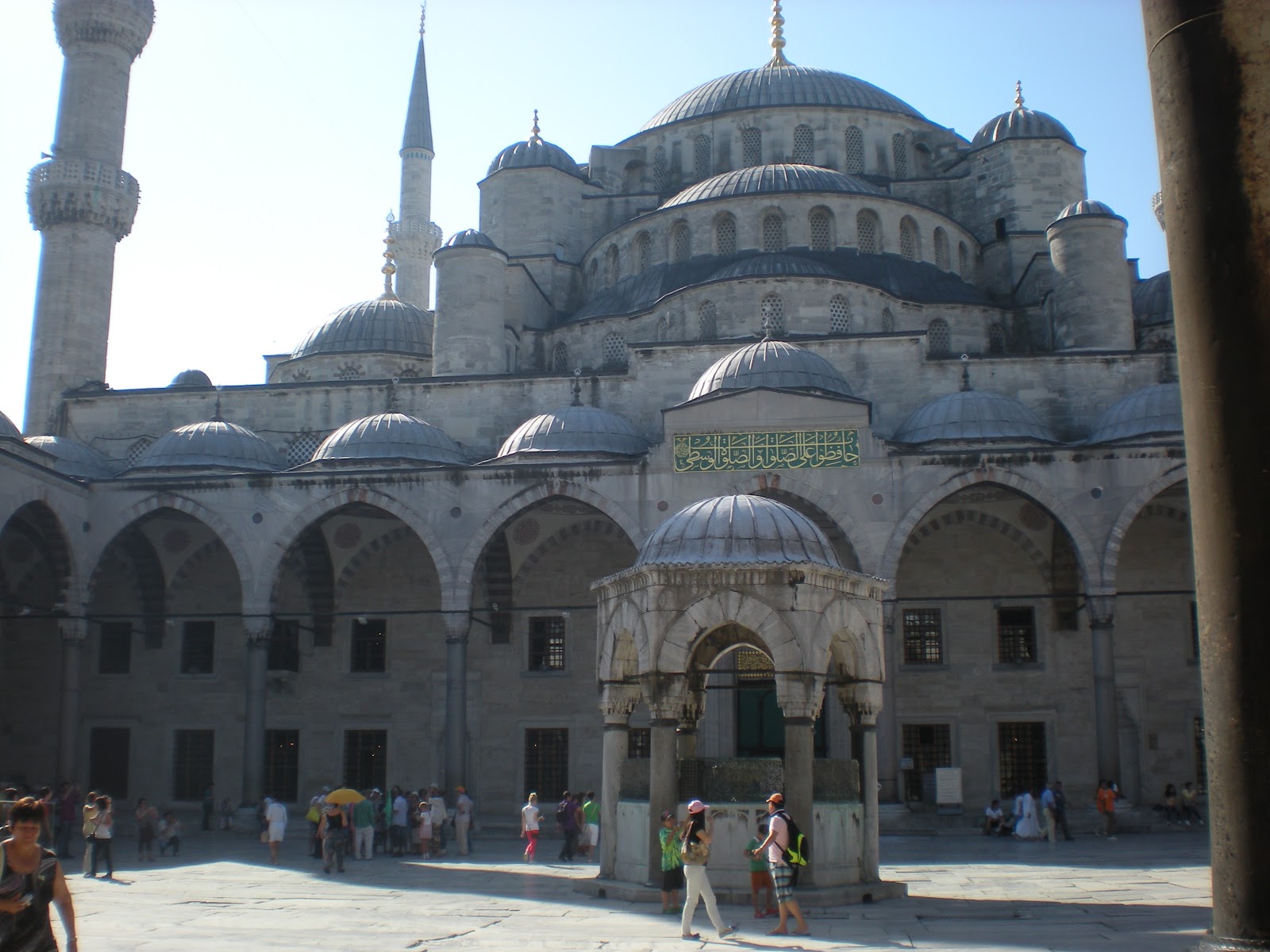
In Istanbul we saw the marvelous sights for which that city is famous: the Hagia Sophia, the Blue Mosque, and the Topkapi Palace.  We also looked around in the Beyoglu neighborhood where the Turks actually outnumber the tourists and where the shopping is good.


                                     Blue Mosque


                               Blue Mosque Interior


                  Hagia Sophia (Or Ayasofia) - Interior


                                 Hagia Sophia Mosaic


We noticed lots of interesting cinema houses here and also a good deal of graffiti and poster art, some of which seemed to indicate that America’s government and its corporations are not as well regarded in Turkey as we, individual Americans are.  Some of the same Istanbulians who couldn’t do enough for us as guests of their nation, seemed absolutely unimpressed with our government’s ability to invade the occasional Middle Eastern country and blow people up now and then with what Bill Maher calls our “flying killer robots,” i.e., our drones.  At least that is the impression we got when we attempted to interpret images like these…


The language barrier was occasionally troublesome for us because, as one of our hosts told us, “The problem is that most of us don’t speak English and neither of you speaks Turkish.”  Indeed.

But all in all, the good-natured generosity and helpfulness of the Turkish people made for a very worthwhile and memorable trip.  In fact, I would have to say that I have rarely been so dependent on the kindness of strangers as we were during out Turkey trip, for one thing that country has in abundance is kind and helpful strangers. Al Hamdilullah.

Friday, May 11, 2012

Portrait of the Smartass as a Young Man

If, when you were 18, you had pounced on a classmate and, while your friends held him down, cut off his bleach-blonde hair even as he cried and screamed for help - would you forget it?

Neither would I.

The things we remember best are those that made us experience a surge of emotion, and surely Mitt was feeling something during his sadistic "rape of the lock" on the shy new kid in school, John Lauber.

So Mitt is a big fat liar.

Politician caught lying! Stop the presses!

No, wait; it's a general principle of mine that no politician who told the truth about everything could get elected in this country.  We demand that our elected officials lie, or we wouldn't vote for them.  The weakness here is not as much in our leaders as in ourselves.  (On this point, see Culture World 9/25/10.)  Although, I would have to say that compulsory lying ordinarily involves policy positions, not the covering up of sadistic bullying.

Obligatory lying by candidates is perhaps more common today, now that ideological purity has taken on, for many voters, a kind of religious quality.  And by many voters, I mean particularly the Taliban-like right wing of the GOP.

But back to Mitt: even more troubling than his dishonesty is his incapacity to connect with people he regards as different.  When he brutalized John Lauber, Romney was acting on the assumption that people had to be like him before they deserved his sympathy, and if they didn't act like him, they could be humiliated and coerced in any manner Mitt and his gang found efficacious.

According to one of his classmates at Cranbrook, when Romney saw Lauber with his avant garde haircut, he said, “He can’t look like that. That’s wrong. Just look at him!”

Social psychologist Jonathan Haidt points out that people whose personalities are prone to conservatism are less open to new experiences than are liberally inclined personalities, and are more likely to be disturbed by those whose behavior is unconventional.  In light of this, we might conclude that Romney is, after all, a genuine conservative and a pretty severe one at that.

But most conservatives are not so disturbed by those different from themselves that they would launch into attack mode and sadistically torture a fellow soul as he cries and screams for help. This is the reaction of a young man so afraid of people he regards as "different" that he can't tolerate their very existence.  And a young man arrogant enough to feel that he has the right to lead a cleansing posse to rid the world of those with whom he can't identify.

Well, bully for you, Mitt.  I daresay you would be a better man had you been on the receiving end of the attack you engineered against John Lauber.  It might have made it easier for you to understand people who are not in a position to own a couple of Cadillacs or hit their parents up for a $20,000 loan.

So, you've had it pretty easy, apparently feeling you've deserved everything you've been handed in life.  And I guess you've always felt you could have your way.  Bully for you.


But please, don't expect us to believe you when you claim you don't remember how you traumatized young Mr. Lauber.  That's one bloody spot that will not easily be washed out.